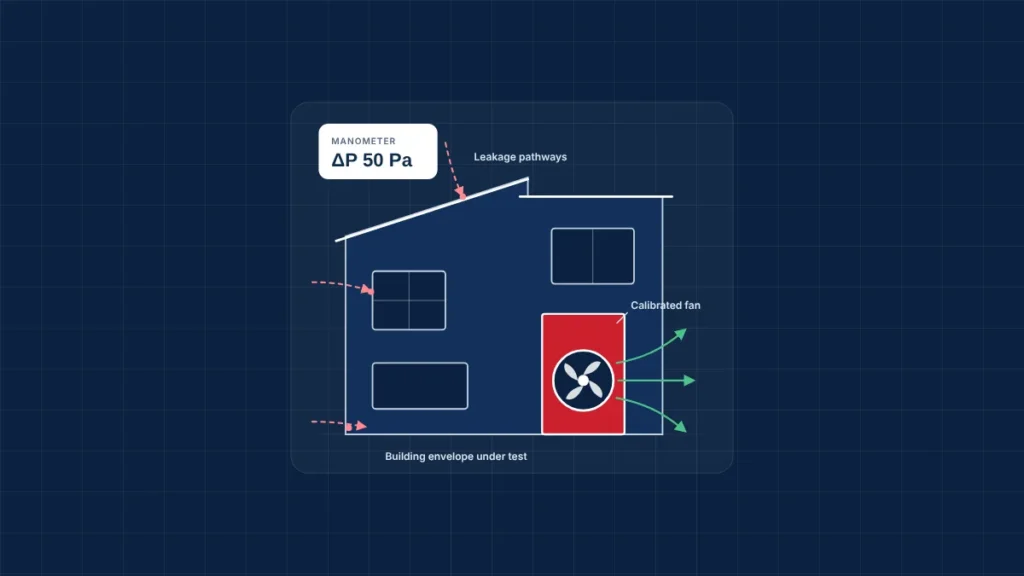
A blower door test is the most widely used way to measure how airtight a building is. It tells you how much air leaks through the building envelope — the walls, roof, floor, windows and doors that separate the inside from the outside — and it can help locate where that leakage is happening.
How a blower door test works
A calibrated fan is temporarily fitted into an external doorway using an adjustable frame and an airtight panel or fabric. Before testing, the building is prepared: external windows and doors are closed, internal doors are generally opened, and some intentional openings (such as exhaust fans or flues) may be temporarily sealed or set up according to the test method being used.
The fan then moves air out of the building (depressurisation) or into it (pressurisation). A digital manometer measures the pressure difference between inside and outside, along with the airflow through the fan. By recording airflow across a series of pressure differences, the technician can calculate how leaky the envelope is.
What the results mean
Results are usually reported at a reference pressure difference of 50 pascals (Pa). Two common measures are:
- Air changes per hour at 50 Pa (ACH50 or n50) — how many times the building’s internal air volume would be replaced each hour at that pressure.
- Air permeability (q50) — the leakage airflow per square metre of envelope area, expressed in m³/h·m² at 50 Pa.
Lower numbers mean a more airtight building. A result is only meaningful when compared with a target that suits the building type, its design and the method used, so it is worth confirming the relevant target with your designer, energy assessor or building surveyor before testing.
Finding the leaks
While the building is held under pressure, leakage pathways become easier to find. Technicians may use smoke pencils, air-velocity readings and thermal imaging to investigate gaps around windows and doors, service penetrations, downlights, roof and floor junctions, and other building details.
When should you test?
- During construction — once the air barrier is in place but before internal linings are fixed, when leaks are still accessible and cheaper to fix.
- At completion — to measure final performance against a project target.
- In existing buildings — to understand draughts and comfort issues, or before and after upgrades.
Standards and requirements
In Australia, building airtightness testing is commonly carried out in accordance with AS/NZS ISO 9972, which describes the fan pressurisation method. Whether a test is required, and which target applies, depends on the building class, the compliance pathway and project-specific requirements — your project team or building surveyor can confirm what applies.
What you receive
A blower door test report typically sets out the test conditions, the measured results, any leakage locations observed and practical recommendations. If remedial sealing is carried out, a follow-up test can confirm the improvement.
Planning a test? Learn more about our blower door testing service or request a quote.