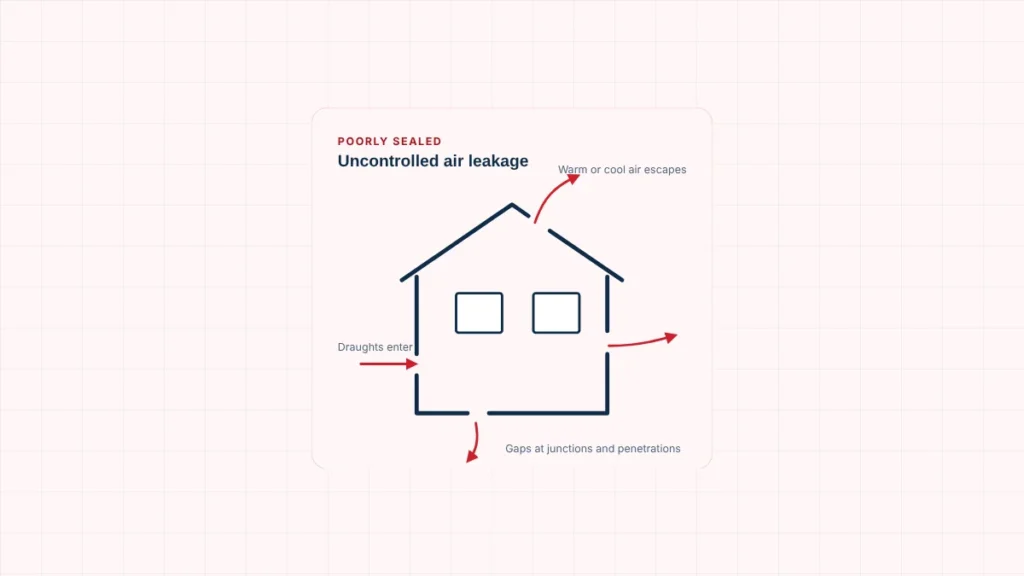
Every building exchanges air with the outdoors. When that exchange happens through gaps and cracks rather than through a planned ventilation system, it is called uncontrolled air leakage — and it can have a real effect on energy use, comfort and the durability of the building.
Infiltration and exfiltration
Air leakage works in both directions. Infiltration is outside air entering the building; exfiltration is conditioned indoor air escaping. Wind, temperature differences between inside and outside (the stack effect) and the operation of fans and HVAC systems all create pressure differences that push air through any available gap.
The energy impact
Air that leaks in has to be heated or cooled to bring it to a comfortable temperature, while air that leaks out takes conditioned air — and the energy used to condition it — with it. The size of this effect varies with climate, building size and shape, construction quality and the heating and cooling systems used, which is why measured testing is more useful than assumptions.
Air movement through and around insulation can also reduce how well it performs, meaning a building may not achieve the thermal performance it was designed for.
Comfort, moisture and indoor environment
- Draughts and cold spots that make rooms uncomfortable, even when the heating or cooling is running.
- Condensation risk when warm, moist indoor air travels into cooler parts of the building fabric, which can contribute to mould and material damage.
- Dust, noise and pests entering through the same pathways.
Where buildings commonly leak
- Around window and door frames, and at sills and thresholds
- Roof and ceiling junctions, including downlights and ceiling hatches
- Service penetrations for plumbing, electrical cabling and HVAC
- Wall-to-floor and wall-to-roof junctions
- Exhaust fans, vents and chimneys without suitable dampers
Reducing unwanted air leakage
The most effective approach starts at design, with a clearly defined air barrier and well-detailed junctions. Testing during construction allows leaks to be found and sealed while they are still accessible, and testing at completion confirms the result. In existing buildings, a blower door test combined with diagnostics helps target sealing work where it will make the most difference.
Remember that a tighter building needs a suitable ventilation strategy — see why airtightness and ventilation must work together.